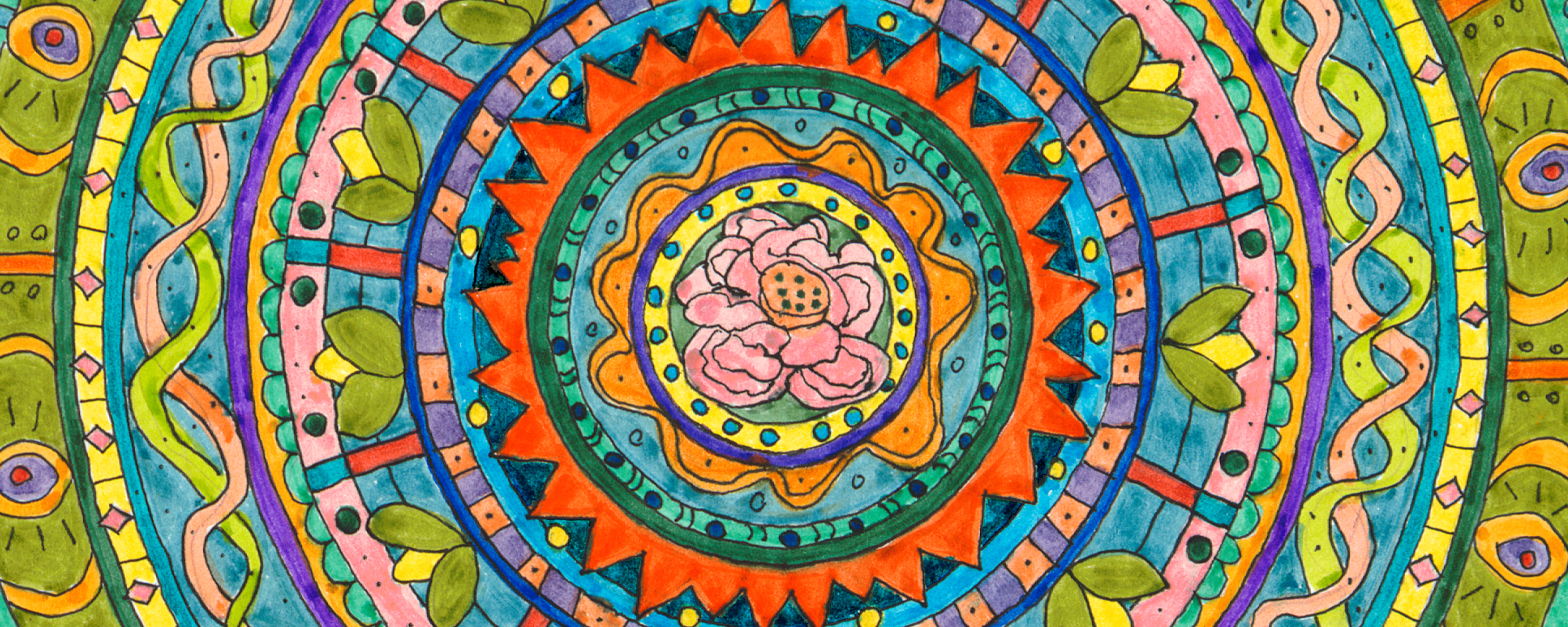
Stillness (Winter)

In early January, I decided that I would make a mandala for each of the four seasons, and that I would complete each one during the actual season it represents.

True to form,  I finished the one for Winter on the first day of Spring.  OK, so I was one day late, but I think that’s not bad.  And the weather cooperated with me totally.  Here on Orcas, it was a gray, cool day, with high, howling winds.  A perfect day to sit down with a hot cup of tea and, work in the small, tight way that these mandalas demand.  A perfect day to finish this project that I have been pondering, doing sketches for, and finally drawing for almost three months.

It was the kind of blustery day I have been longing for all winter.  We have had a pretty mild winter, with not enough of the drama that I look forward to so much.  No loss of electricity since Thanksgiving.  No cancelled plans.  No sense of that deep quiet that I count on for renewal.  No compelling reason to rest.

It has been a challenge to sit down and find that place of deep winter stillness within myself, and even more of a challenge to figure out what that “looks” like.  Isn’t the whole concept of stillness the absence of imagery?  How could I make something that is still and visually interesting at the same time?  Within that challenge, I got to a place of conditional peace.  Within my busy mind, I willed stillness to come to me.  I breathed it into my yearning heart.  I wanted this mandala to be dark and a little mysterious as I perceive winter to be.  But of course, I wanted it also to reflect the promise of light and warmth both inside and outside my true self.

Staying Inside the Lines

We just had a wonderful three-day visit from Dennis’s son Ryan and our five-year-old granddaughter Leah. One of her favorite activities is to color, so I had bought her a mandala coloring book which turned out to be a really fun thing for us to do together. I had this realization that basically I have been coloring for four years, ever since I started drawing mandalas. What is strange is that I never really figured it out before.

Anyway, at one point, Leah said, “I like the way you color. All I know how to do is scribble.”

It was such an endearing thing to say, and I asked her if she would like to learn an easy way to help her stay within the lines and she said “yes.” I explained how she could use the black lines and first outline a shape in the desired color and after that begin to fill in the space. She tried it out and caught on really quickly, and I was so pleased that I had been able to teach her something.  She was very diligent about it for a while, but after a few minutes, she reverted to scribbling again.  I asked her why and she said, “I just like to scribble.”

That really made me think about how a child makes the transition from scribbling to being able to stay between the lines, and about what is gained and what is lost when that happens.  Leah knows.  Scribbling is fun.  It is free, wild, daring.  It isn’t afraid to go outside the lines.  It makes a bold statement.  I wonder why did we ever have to learn to stay inside the lines?  Who taught me?  When?  Why did I let it happen?  Is it too late to go back?

Pictured above is one of our best collaborations, with me trying to be looser, and Leah trying to stay inside the lines.

Seeing in a New Way

Last week, I took my annual trip to Chicago, the city where I grew up and where my mother lived until her death over three years ago. While she was alive, I went there more and more frequently. But now I content myself with an annual pilgrimage to see family and friends, and to revisit my roots.  My continued visits to the city are somehow really important to me.  Yet another circular experience in my life.

How many thousands of times have I walked on Michigan Avenue where this photograph was taken! But not so often with camera in hand, feeling part tourist, part long-time resident. Waiting to be surprised by the city I still know so well.

So as I looked through the lens, I was really pleased to capture these three iconic Chicago landmark buildings in one shot.  In the foreground is a part of the original Water Tower, which is one of the only buildings to have survived the devastating Chicago Fire of 1871.  In the middle is just a small slice of the “new” Water Tower, a six story shopping center which has become a destination in itself.  How perfect that the words were the only things framed by this view. And in the background stands the distinctive Hancock Building, once the tallest building in the world, now not even the tallest building in Chicago.  The tiny shape of the tall building in the upper right corner is the Ritz Carleton Hotel, one of Oprah’s many homes.

I was truly delighted to see all this at once.  It made the proximity of all these buildings very real to me, and their juxtapositions brought thoughts about architecture, urban planning, and the symbolism attendant on the giants of commerce they house.  I gained new insight about the process of seeing and about the so-called happy accidents of photography.

What Do You Mean?

That is the title of this painting which may or may not be finished.  Or may need some minor adjustments.  Or may just be one that I’ll never feel resolved about.

I like to work on several things at once, and I like the idea of  doing several paintings of the same size at one time.  This was one of a series of six paintings on paper, five of which I finished last summer.  But this one had me stumped then and it still has me stumped now.  I keep working and reworking it.  I’ll feel good about it for a day or so.  And then I’ll want to tweak one little thing and that will lead to something else, and then I just keep painting until the surface of the painting starts to feel good again.  Then I work on other paintings for a while, and I keep looking at it.  Then the whole process starts all over again.

I keep asking what the painting is trying to teach me.  Every time I work on it, I ask, “What Do You Mean?”   So no matter how many more times it changes, that is the title.

What I like about this version is that the colors are a bit loud, a little blunt.  That’s not usually me.  There is chaos but order, too.  I like that they are playing with each other, but not at odds.  This piece might defeat me in the end, but I am thoroughly enjoying the process.

Finished!

I was just about to use an unfinished coiled basket for today’s entry when I realized that it would have been the third week in a row that I had used an incomplete piece to express an artistic process or feeling about making art.  It was too weird and too much of a pattern about my life.  In the middle of twelve things, having trouble finishing anything.

Now there can be a beauty and a wonder in the incomplete.  Coincidentally, I was reading an article in Art in America this past week and found an amazing quote from a Chinese Tang dynasty historian named Chang Yen-Yuan.  Here is part of that quote: “From the moment one knows that a thing is complete, what need is there to complete it?  For the incomplete does not necessarily mean the unfulfilled.”

So beautifully inscrutable.  So open to interpretation.  So potentially important to the process of painting (more on this some other time).  But so utterly damaging for completing concrete tasks, and such an easy way out for one who loves to procrastinate, and to procrastinate some more.  Until there are those twelve unfinished projects jamming up my life and my creative process as well.

So I stayed up until 2 am last night and finished this ruffled, peyote stitch, beaded bracelet.  Yeah!  It can be done!